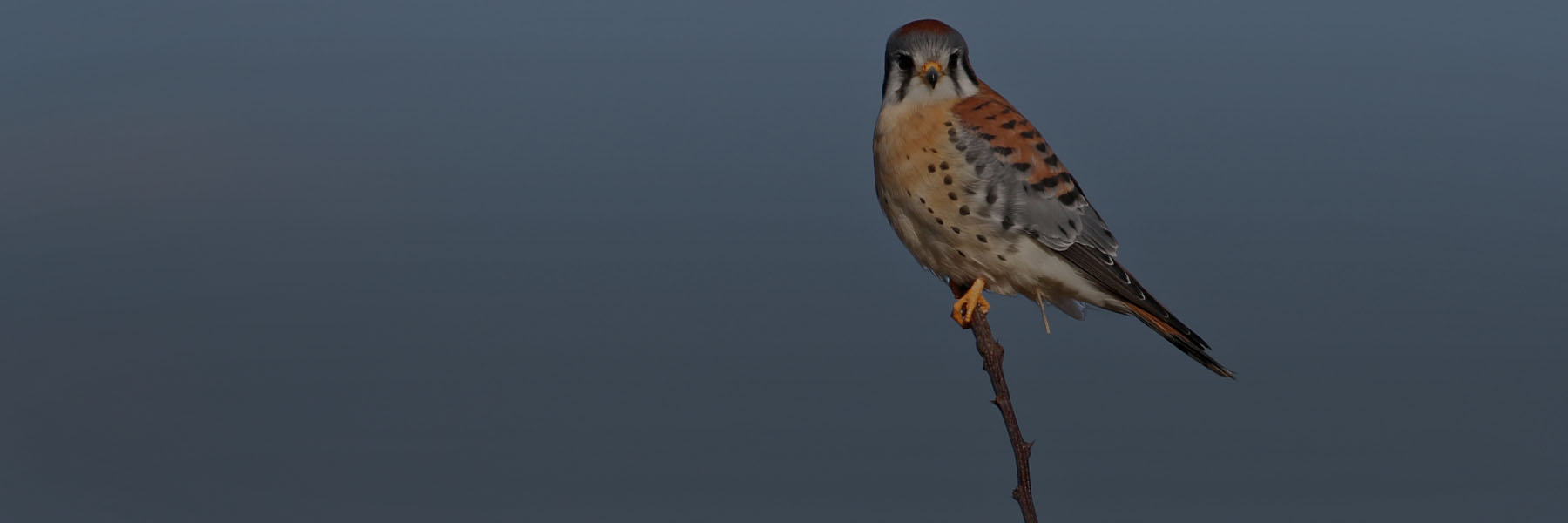
Last weekend, I visited a park in New York City for the first time – Marine Park in Brooklyn. This park features fields and a salt marsh that provides habitat to a variety of birds. The bird that welcomed me happens to be my favorite little bird of prey – the American Kestrel. I was able to walk up close enough to finally get some decent photos of this beautiful bird.
American Kestrel perched on top of a tree
Later on in the day, he was hovering over the fields in search of dinner. I only grabbed a couple of decent photos of this since the sun position was not ideal and he was facing away from us. Still, I was happy to get a few shots of it hunting.
Kestrel hovering with Brooklyn in the background
I am still working my way toward getting even better photos of this little bird. For now, these will do just fine in my collection.
Last Sunday I visited the park that started my interest in birds, Colonial Park in Franklin Township, New Jersey. I did not have very high hopes for seeing birds, but wanted to visit that park, for the first time, while I was a birder. The best bird sighting, however, happened on the way to the park – as we were heading toward the intersection of Mettlers and Weston Roads, I spotted Cranes foraging in a corn field. We stopped the car behind some junipers, as to not disturb the birds and got out to take some photos.
We counted twelve individuals, including one juvenile. This turned out to be a high count for this area. In the past, a group of Cranes were often seen a couple of miles north of that area in a field that is now planted with soybeans. Since they do not eat soybeans, they had found this new field that we just happened to pass by at the right time.
Below are some photos of the birds as they moved down the field.
Last weekend, on December 20th, Pocono Mountain held their annual Christmas Bird Count (CBC). The CBC is a bird census, sponsored by the National Audubon Society, where birders across the Western Hemisphere count birds over a 24-hour period within 15-mile diameter circles. I live in a private community, Penn Estates, which happens to be right in the middle of one of the areas for our local CBC that is not usually accessible. My friend and I volunteered to count within the gates so that the area is not left out.
Black-capped Chickadee
Penn Estates is a residential, yet very wooded, community in the Poconos that gets a nice variety of wildlife including over one hundred species of birds that I have found so far in two years. Our count was a little slow, likely due to the nicer weather that is keeping the winter birds north, at 22 species. Our highlights included a calling Eastern-Screech Owl, a nice flyover Red-tailed Hawk and two Ravens at the end of the count. Birds that we likely should have seen that we dipped on include a resident Great Blue Heron, Pileated Woodpeckers, Brown Creepers, White-throated Sparrows, Purple Finches, Pine Siskins, Red-shouldered Hawks and Turkey Vultures. We also could have tried harder to call out a Barred Owl who I have previously heard calling near my friend’s house, which is not far from the Tannersville Cranberry Bog.
Red-tailed Hawk
Many of the birds we found were hanging around the three small lakes within the community. We had a surprisingly small amount of luck at bird feeders, which probably means that the natural food is keeping the birds satisfied.
Tufted Titmouse
The following table summarizes our counts:
Species#
Canada Goose1
Mallard21
Red-tailed Hawk1
Mourning Dove16
Eastern Screech-Owl1
Red-bellied Woodpecker6
Northern Flicker1
Downy Woodpecker6
Hairy Woodpecker1
Blue Jay7
American Crow8
Common Raven2
Tufted Titmouse87
Black-capped Chickadee69
White-breasted Nuthatch31
Carolina Wren4
Eastern Bluebird3
Northern Cardinal3
Song Sparrow2
Dark-eyed Junco87
American Goldfinch4
House Finch1
I will most likely do the same next year so that my community is no longer left out of the CBC due to restricted access. Even with the low number of birds, it was a fun morning!
At the end of the summer, my friend and I were looking for birds at Pinebrook Park along the Brodhead Creek. We both heard something behind us and turned to see a small surprise.
A Black Bear gets into the creek
This Black Bear quietly made it’s way to the creek without us noticing, about twenty feet away. It got right in the water and crossed to the other side.
Bear crossing the creek
On the far bank
The bear’s fur was soaked! But it probably felt pretty good in the heat.
Dripping water
What’s a bear to do?
After situating itself on the other side, it shook the excess water off.
Lighting was a little tough, but we still managed to get a few keepers of it on the other side of the creek.
Posing on an open log
Within five minutes, it disappeared into the woods on the other side.
I have many great memories from my trip to Florida earlier this year – most of them involve my favorite birds – waders. One that really stands out is a “honey hole” that we ran into on Blackpoint Wildlife Drive in Merritt Island. It was a small pond that must have gotten fairly deep surrounded by White Ibis, Snowy Egrets and one of each of a Tri-colored and Little Blue Heron.
Snowy Egrets, White Ibis and Little Blue Heron
When we drove up, a car was already parked at it, so we went in behind and waited our turn for the “best seat.” We were still able to pick up on the action from the distance. The Ibis were foraging at the edge of the pond while the Egrets and Herons wandered around. Eventually, the other car moved on and we had front row seats.
Juvenile White Ibis
Little Blue Heron coming in while we waited
Little Blue Heron pretending to be a Snowy Egret
The little pond was so full of birds that they Snowy Egrets were showing a little attitude towards the others when they got close.
Roused Snowy Egret
The most interesting part, however, was how the Egrets and Herons would go after fish. We watched as they would skim the water with the tip of their toes and reach down to grab a fish.
Tri-colored Heron crossing the pond
Tri-colored Heron going all in
Snowy Egret reaches in
Snowy Egret grabs a fish
They would, for the most part, come up with a fish.
Tri-colored Heron skips across the pond with a fish
Snowy Egret crossing the pond with a fish
At times, the birds would go at the same time.
Two Snowy Egrets with fish
Two Snowy Egrets take on the pond simultaneously
Which led to a few mid-air collisions…
Snowy Egrets collide
Snowy Egret and Tri-colored Heron skimming at the same time
And then they collide
But do not miss a beat in air
I did capture a video of the action with my phone.
Eventually, a bird that we were waiting to photograph flew in – a Roseate Spoonbill!
Roseate Spoonbill Joins the flock
This was the first time we were able to photograph an adult up close. It stayed at the edge with the Ibises.
The Spoonbill stayed at the edge
Foraging Spoonbill
Roseate Spoonbill
It stayed for a little while before flying off – I was very happy with this photo session! We photographed at this little spot for over an hour even though the sun was high. What a great spot!
Northern Saw-whet Owl in hand, taken with my iPhone
The coolest part about it was seeing the bird under a black light. Birds feathers display UV patterns which can indicate the age of a bird. This Northern Saw-whet Owl’s feathers were glowing pink across the under side of its wing, which showed that it was a hatch-year bird.
Left wing under UV light
Right wing under UV light
If the bird had older feathers, they would not glow as bright as the newly grown feathers. For more information on this, check out my friend Ann Nightingale’s article on BirdFellow, Pretty in Pink: The Northern Saw-whet Owl’s Flashy Secret.
Once all of the measurements were taken, the banders allowed me to release the bird. It’s so tiny!
Me holding the Owl before release; photo taken by my friend, Steve
Once the bird was released for the second time, it stuck around in a nearby tree, allowing us to get some nice photos. I used the light from our headlamps to lighten the bird up rather than using a flash. It was a great experience to see this tiny owl up close. I hope to do it again next year!
Northern Saw-whet Owl hiding behind the leaves
Northern Saw-whet Owl perched, after getting banded
In mid October, my friends and I took a weekend trip to Cape May. We ended up going a month later than usual to see what warblers we could find. One species completely blew out the rest in numbers, the Yellow-rumped Warbler.
Yellow-rumped Warbler, Myrtle sub-species
Our first stop was Forsythe – we were greeted with hundreds of Yellow-rumps right near the main parking lot.
Yellow-rumped Warbler
Yellow-rumped Warbler on cedar
They were all over the dunes of every beach we visited, hopping on the fences or foraging around the sand.
Yellow-rumped Warbler on a fence
Yellow-rumped Warbler on a fence
One of the trees that they preferred were the cedars that are abundant throughout the coast.
Yellow-rumped Warbler in cedar
Yellow-rumped Warbler off of the hawk watch
We also saw a ton of fly-byes, especially during the Higbee morning flight. In total, I am confident that we saw well over one hundred, if not two hundred thousand individual Yellow-rumped Warblers during the weekend. They were everywhere!
Yellow-rumped Warbler at Cape May Point State PArk
A couple of years ago I started a tradition of sharing photos of my favorite bird species from my fall trip to Cape May – the Black Skimmer. The photo opportunities seem to keep getting better and better each year. This year brought more flight action along with other unique shots.
Black Skimmer in flight
Black Skimmer flapping
This year, we stayed at a hotel near the beach. We could see the skimmer flock flying around the beach right from our window! It was nice to be able to walk over to them without even having to get into a car.
Black Skimmer flock
The Skimmers would often take flight and skim the ocean.
Black Skimmer skimming
Black Skimmer skimming
Black Skimmer skimming into a wave
Black Skimmer skimming the surf
While others were a bit lazy about getting their food.
Lazy Black Skimmer
After skimming, they would land in the shallow water and bathe when the waves hit.
Black Skimmer bathing
Synchronized bathing
Two Skimmers after they are done bathing
Young Skimmers found interest in objects along the beach; they would poke and prod at shells, sticks and rocks.
Black Skimmer flipping an oyster shell
Black Skimmer attempting to pick up a larger shell
Black Skimmer claiming its found object
Black Skimmer toying with a stick
Many of them were a bit more lazy in-between Skimming and took a snooze on the sand.
Adult Skimmer laying in the sand
Black Skimmer head-on
Young Skimmer resting on the sand
As with past years, the Skimmers would preen between snoozes.
Black Skimmer preening
Black Skimmer stretching
Black Skimmer rousing
Black Skimmer after a stretch
This was another great year with my favorite Skimmer flock.
I’ve had a very welcome visitor in my garden since late last week. It ended up being the very first subject shot with a new lens that I purchased on Saturday.
The first photo op I had with my new lens
The bird is an Ovenbird. It looks like a thrush, it acts like a thrush, but I promise you that it is not a thrush. The Ovenbird is a larger-sized Warbler that forages on the ground and has a familiar song that echos through the forest in the summer.
I first noticed this bird on Friday while I was watering my plants. It was near the area under my feeders along with some Mourning Doves and Chipping Sparrows. I did not try to get a photo of it on that day. The bird has been seen often every day after that. I even caught him bathing in my small pond.
Bathing Ovenbird shot through my front window
He searches for food all around my garden – he must be finding some good stuff!
Ovenbird foraging around my garden
When I saw him today, he only ran under one of my shrubs, only to come right back out and continue his search. This bird is gearing up for migration to Mexico and has very little fear of me.
This Ovenbird seems to like the perch over my pond
I have been chasing Green Herons since before I was a birder. I could never get good photos of them because they would fly off before I even saw them. The Herons from New Jersey were just too shy!
The only halfway decent photo I had of a Green Heron from 2009
During my trip to Florida earlier this year, I ended up having a few different photo ops with this species in a couple of locations.
Getting closer to the perfect Green Heron photo
I finally got the photos I’ve been wanting! Here are some of the better ones: