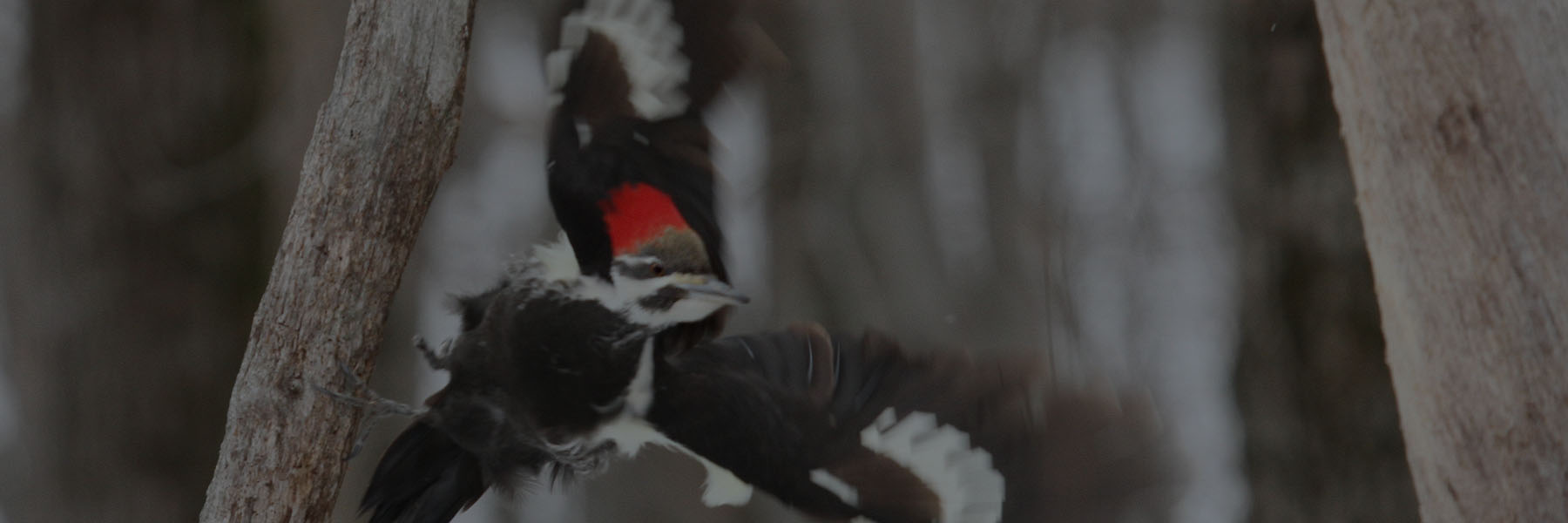
The Pileated Woodpecker has been a nemesis bird for my camera for a long time. I heard and saw them often at my old house in New York, but only had a decent photo op once, from across a creek while the sun was setting behind the bird.
My local Pileated Woodpecker from New York
Sure, it’s a nice enough photo, but it was the only time it happened — until I moved to Pennsylvania. My backyard is all wooded and backs into about an acre of a non-private, mature forest. With age comes dead trees and a ton of trees with dead limbs. I get a lot of Downy Woodpeckers, a couple of Hairy Woodpecker pairs, a Red-bellied pair and also Flickers – along with my favorite, the Pileated Woodpecker.
The Pileateds are very vocal – I often hear them banging on trees or making their “kuk kuk” sound. I can usually easily find them, especially when the leaves are not so full. There are two areas that they prefer – a very dead and large Oak tree behind my house and a dead stump in front of my house. I’ve gotten my best photos from these trees – especially the one in the back.
Just today, the female was flying from tree-to-tree all around the woods. Every tree she stopped on had either a dead limb or holes to inspect.
Female Pileated Woodpecker inspecting a hole
They are always finding really good grub to feast on!
The male Pileated Woodpecker with a mouth full of grub
Female Pileated Woodpecker with her tongue out
They really do make a mess – The large oak already has plenty of holes in it and it’s only a matter of time before it has no more bark left.
Male Pileated Woodpecker chipping away at the oak
Female Pileated Woodpecker making a mess on newly fallen snow
I take most of my photos from either one of my decks or from my bathroom window, which gets me a nice look at the top part of the dead oak. I can open the window and shoot away without disturbing the birds. They also never seem to mind me while they are busy chipping away at the trees, as long as I do not make any sudden motion toward them.
Pileated Woodpecker with her crest up
Female Pileated Woodpecker in a thin tree
Male Pileated Woodpecker
Female Pileated Woodpecker
I am so happy to share my yard with these wonderful birds!
For the past two years, I purchased a cut Christmas tree with a higher motive than just being festive. First, I knew my cats would enjoy it while it was indoors – and they did, for a little while. I knew they would get bored of it quickly, so they were not the main reason for getting a tree – I mostly do it for the birds. After Christmas is over, I like to move the tree outside on the deck that I feed my birds from. I place it between my feeder poles to give them protection while feeding. When winter is over and the tree starts to turn brown, I will bring it to my yard (aka the woods) and add it to my brush pile. This won’t happen for a while though – Fraser Firs stay green for a long time after cut.
Last year (left) and this year (right)
A variety of my backyard visitors use the tree as a perch while waiting in line at the feeders and also as protection from the weather elements.
Dark-eyed Junco
American Goldfinch
Pine Siskin
Tufted Titmouse
Carolina Wren
The birds love using the tree, especially in poor weather.
Dark-eyed Junco
Pine Siskin
Last week, we had very high winds with extremely cold temperatures. My tree was tipped over and I noticed that the birds were huddled close to it. I went out, adjusted the tree for optimal wind protection and poured some seed in and around it. The birds approved.
Using the tipped tree as protection from the wind
I often pour some millet on top of the tree. A lot of it ends up sticking on the branches and the Juncos go crazy for it.
Dark-eyed Junco eating millet
They also use the tree as protection when danger lurks nearby.
This Sharp-shinned Hawk was trying to pick off finches, some hid in my tree
If you don’t do this already, I highly recommend using your tree for the birds. You will get the most out of it and so will they!
I think I have an addiction – an addiction of photographing the Pine Siskins who have been visiting my deck this winter. My Flickr followers must be getting sick of seeing upload-after-upload of Pine Siskins (I try to break it up a bit with some other birds). How could I not photograph them though? I get anywhere from thirty to seventy visitors at a time. They are very active and don’t even mind it if I stand outside with them.
I do not want to flood my Facebook followers with all of these Siskin photos since there are so many that I like, so I will share a bulk of them in this post.
I get plenty of photos of my Pine Siskins on the branches that are attached to my feeder poles.
When it snows, I get even more photos.
I set up my old Christmas tree, a Fraser Fir, in-between two of my feeders. The birds use it as cover and a place to wait their turn.
They often perch on the top branches.
And at the very top of the tree.
These birds are one of the most aggressive song birds I’ve seen at feeders. They spend more time defending their territory than they do actually feeding. I have five stations set up for them – two thistle feeders, two black oil sun flower seed tubes and a sunflower heart tube. They also go after the suet and seed cakes. Still, they decide to fight each other. If they spent less time fighting, they would not use up so much energy!
On a day that I had around seventy birds, I took a video with my phone. They did not seem to mind me and kept up their routine like I was not even standing there.
I hope you enjoyed these photos as much as I liked taking them!
Last weekend, I took an impromptu birding trip with my friends, Jon and Steve. Steve invited us along to chase a Painted Bunting that was just over the Pennsylvania border in Andover, New Jersey. A beautiful male life bird at a private feeder that can be viewed from a public trail? Sounded like a plan! We had vague plans afterward to go to Wallkill New York for some field birds. We had no idea what the day would end up being as epic as it was.
When we arrived at the location for the bunting, it started to snow. Thankfully, the bird had been hanging out in a tree right before we got there. After a nice scope view, he flew to the feeder.
Painted Bunting on a private feeder
A life bird for all three of us. He flew into the brush shortly after and disappeared for some time, probably finding shelter from the weather. Satisfied enough, we left and made our way to Wallkill, New York.
On the way up, we drove through some farmland back roads and said hello to various local cows. We found a large flock of Horned Larks feeding on the melted parts of the field. Every time they would get close, a car would pass, so I did not get any good photos of them.
We arrived in Wallkill almost two hours later. We made our way through the marked paths, even though the snow was a foot or more deep. The first owl was spotted in the distance, followed by another who wanted the perch. We saw several Rough-legged Hawks flying around and perched in trees – at least six of them that we could differentiate all at once. We also saw a Bald Eagle flying in the distance and a Red-shouldered Hawk perched near the parking lot.
Rough-legged Hawk in flight
We walked around the paths, through the deep snow, looking for any way would lead us to a better location. We decided to go to a hunting blind across the field where some of the owls were perched (one was ON the blind). While we were walking, most of the owls slowly made their way into a single tree stand. It was really cool to see all of them in one spot!
Four Short-eared Owls in the trees
I also got my closest views of this beautiful bird.
Short-eared Owl perched
We made out way to the blind, but just as I set my camera up, the owl who was perched nearby flew off to meet the other birds.
Short-eared Owl in flight
We decided to settle in the blind to see if the birds would come in close. That lasted all of five minutes after I checked Facebook to see this message:
3:30 PM Saturday: Curt McDermott reports that the GYRFALCON is being seen now at Hoagerburgh Road near Bates Lane at Blue Chip Farm, Wallkill, Ulster County
That was in the exact area that we were. This Gyrfalcon was reported the day before, but they aren’t known to stick around, so we did not have high hopes of seeing it. That changed quickly! We trudged back through the snow to the car and made our way to Bates Lane. The line of cars gave the exact location away.
This is not even a quarter of the Gyrfalcon crowd, more were in front of me
We could see the bird sitting on top of a pole as soon as we got out of the car. It stayed in the same spot for the entire twenty-or-so minutes that we hung out until a Red-tailed spooked it off. It was nice to watch the flight too!
Gyrfalcon iPhone-scoped
Scope views were beautiful. This was not my lifer Gyrfalcon – I saw one at Montezuma National Wildlife Refuge a couple of years ago, but I did not get these same killer looks at it for this long, let alone decent photos, so this was a real treat.
We started the day with a rare bird from the southern US and ended the day with a rare arctic visitor. In-between these two amazing birds, we saw six Rough-legged Hawks and seven Short-eared Owls – two species that the three of us enjoyed very much. This day easily completes with the top birding days of my “career!”
For the past two years, I had the honor of being on the blogging team for The Biggest Week in American Birding. I am attending the festival again this year and will continue my position as a volunteer. I will also be more active on social media in general for the event, so look out for bird-filled photos and posts from me!
Are you interested in contributing to the greatest spring event around? There are currently many positions to be filled including Registration Packet Assembly, manning tables and being desk hosts, field trip leaders, trip bus drivers and more. Every effort helps make this festival a huge success. You even get some perks out of it like FREE registration, a festival t-shirt and a bag full of festival goodies. The best part is knowing that you helped an event that thousands of people from all around the world come to. More information can be found at the Biggest Week website.
Registration will open very soon – you will want to register quick because field trips fill up fast. You can go on guided bird walks and van trips, boat and canoe trips and you can also have the chance to go on trips with some of the biggest names in birding. If you need a break in the afternoon, there are various bonus presentations being offered as well as workshops and evening keynote speakers. Free with your registration are daily guided walks around Magee Marsh, evening socials, a birder’s marketplace, bird banding programs and more!
What makes birding here so different than anywhere else? Not only is the energy above the clouds, but you will see tons of birds. Magee Marsh is full of bright and colorful migrants.
The Cape May Warbler is one of many birds you will see
If a rare bird is seen in the area, you can get notified with the details on Twitter by following @BiggestWeek.
Black-bellied Whistling Ducks nearby? Relax! You will know about it.
It’s not just Magee Marsh – you can explore other parks and preserves that the area has to offer.
This Sora was foraging at Pearson Metropark, right next to our car
Cliff Swallows at the bridge to Maume Bay Lodge
If there is an owl in the area, you will know about it. Who DOESN’T like owls?
An Eastern Screech-Owl is always hanging out above the boardwalk
And, of course, you will meet some pretty great people, including some of birding’s top birders and book authors. Oh.. and did I mention the BIRDS??
I have finches on my mind because I had two special visitors to my yard this week – Pine Siskins and Common Redpolls. These species are not always in my area, but will find their way further south during irruption years. Irruptions occur when there is a lack of food in the birds’ normal wintering grounds. They can be easily overlooked if you do not know what to expect. A Siskin can be mistaken for a Goldfinch, a Redpoll for a House Finch. If you see these birds, do you know what to look for?
This blog will show you some simple differences between some of the finches found in northeast Pennsylvania. I’m not very technical when it comes to bird identification so this post is put together through my own observations. I’ll start with a compilation of frontal views of the birds I will discuss. Do you think you can name them without looking at the answers?
The answer key for these finches is at the end of this post.
A very common backyard bird is the House Finch. They are mostly brown finches with streaking on their stomachs. The males have red on their faces, chest and rump.
Two male and one female House Finches
A similar species to the House Finch is the Purple Finch.
A female Purple Finch with a male in the background
They almost look the same! Let’s take a closer look at the males and females of these two species, starting with the males. Male Purple Finches have bolder markings on their face, more coloring on their wings and their bellies have a lot less brown streaking (if any at all). They usually seem to be a much brighter raspberry color than the House Finches, though that is not a good field mark since some House Finches can also have brilliant coloring.
Male Purple Finch
The duller male House Finches can be pretty easy to differentiate from the male Purple Finch. Their color can also vary from red to orange to yellow.
Male House Finch
Some House Finches can be very bright and are confused for Purple Finches. The best way to determine that it is not a Purple Finch is by the brown streaking on the belly and lack of red on the wings and back.
Male House Finch
Now lets look at some females. The female Purple Finch also has very bold markings on her face. This is probably the best way to tell them apart. She also lacks any streaking under her tail, unlike the House Finch, but that can be more difficult to see.
Female Purple Finch
The female House Finch lacks the strong facial markings. The streaking on her underparts is also a bit thinner than the Purple Finch. She also seems more brown overall (to me, at least).
Female House Finch
Moving on to another bird that many people know – the American Goldfinch. In breeding plumage, the male Goldfinch is unmistakable with his bright yellow body, black cap and wings.
Male American Goldfinch in breeding plumage
The female is also very bright in breeding plumage, but she lacks the black cap and has duller wings. Still, she is an easy bird to identify.
Female American Goldfinch in breeding plumage
This bird loses and replaces it’s bright colors with more drab yellows and browns every fall. This is what the same bird looks like during the fall and winter months.
Male American Goldfinch in non-breeding plumage
Female American Goldfinch in non-breeding plumage
Insert some winter visitors into the mix. The two more common winter visitors where I live are the same size as the Goldfinch and I often see them flocking together around food sources: Pine Siskins and Common Redpolls. These birds typically only show up during irruption years.
Pine Siskins have brown streaking with subtle yellow markings around the edges of their wing and tail. They can be very easily confused with female House Finches, especially if the yellow is not very apparent. A huge key difference in the species are wing bars and the long, slender bill.
Pine Siskin
The yellow is more easily seen when the bird flashes its tail or wings.
Pine Siskins flashing their yellow
Some of them do have more noticeable coloring while perched. There is also a small percentage of them are the more extreme-colored green-morphs.
Green-morph Pine Siskin
Common Redpolls, on the other hand could be confused with Siskins at a distance or male House Finches at a quick glance. They have brown streaking and a short, slender bill. Males have red coloring on their chest and upper flanks.
Male Common Redpoll
Female Common Redpoll
There is also the rare Hoary Redpoll that can visit over the winter months. This bird is much more pale than the Common Redpoll, the streaking is fainter and the bill is smaller. The males have an even slighter hint of red on the chest.
Male Hoary Redpoll
Here is a [poor] photo of three of these birds at my feeder at the same time.
Pine Siskin, American Goldfinch and Common Redpoll
They are about the same size but when they are together, you can see the differences very easily.
Think you have a handle on it? Here are a few photos of some of these birds side-by-side. Can you determine who is who without looking at the answer key?
What species of Finch are these?
Who are these male birds?
These are fledglings of two of the birds in this post. They look like the females of the species.
How do you think you did? I hope my basic lesson on these birds helped you figure out which species these birds are.
Answer Key:
Top photo: from top left to right: American Goldfinch, Pine Siskin, House Finch (male); from bottom left to right: Purple Finch (female), Common Redpoll (female), House Finch (female)
Bottom photos: first photo: House Finch (female) and Pine Siskin; second photo: House Finch (male) and Purple Finch (male); third photo: House Finch (juvenile) and Purple Finch (juvenile). Yes, I did put all of the House Finches on the left side on purpose.
Earlier this month, three of my friends and I took a trip to the New Jersey coast to look for wintering waterfowl and sandpipers. Knowing that the temperatures were going to be well below-freezing, we bundled up and prepared for a windy day. Our first stop was Barnegat Light and the jetty that I have a love/hate relationship with. I hate it because you have to be careful going from rock-to-rock and it can be slippery when wet. But at the same time I love it since it always brings us good birds. The rocks were icy, but the birding turned out to be pretty good!
My friends returning from the tip of the icy jetty
On our way down the jetty, we spotted a single Dunlin on the beach-side. It didn’t seem to want to move, though it didn’t look injured. For a moment, it seemed like it was just frozen in place.
A lone Dunlin
We found one brave songbird on the jetty. It also did not seem like it wanted to move far.
Savannah Sparrow on the rocks
Last winter, we had plenty of waterfowl close in the inlet, but both time I went to Barnegat this season it was different – there were hunters in boats close to the jetty, which kept the waterfowl distant. There was a large grouping of Eiders in the bay, but harsh light and distance made for poor photo ops. They were mostly Common Eiders, but we did spot one King. Many Common Loons and some Red-throated were also present. Scoters were even more distant with a few Black Scoters coming near the jetty. A single pair of Harlequins came in close.
The only pair of Harlequin Ducks who came in close
Harlequin Duck drake flying by
We did run into the usual flock of Dunlin and Ruddy Turnstones on the jetty. They were huddled and did not care to move as we passed by. The Purple Sandpipers were on the very tip and I did not go close enough to photograph them.
The flock of Dunlin stay warm
Ruddy Turnstones with the Dunlin
Dunlin on ice
Ruddy Turnstones using a rock to break the wind
On the way out, we walked on the sand so that we could keep our eyes on the dunes for buntings, larks and longspurs – and also to keep warm since all of us seemed to lose feeling in our fingers. We ended up seeing a ton of Yellow-rumped Warblers.
Yellow-rumped Warbler on the path
Other highlights from Barnegat included a couple of close fly-bys by a juvenile Northern Gannet, a male Northern Harrier hunting the dunes and an unexpected Bonaparte’s Gull. On our way off of the island, we checked out a few marinas for more waterfowl. We got distant looks at Bufflehead, Horned Grebes, Loons, Pintails, Black Ducks, Long-tailed Ducks, Gadwall, Goldeneyes, Red-breasted Mergansers and Ruddy Ducks.
After that, we chased reports of a Cackling and Ross’s Goose on the way to our next destination. The birds were not present, but there were some other friendly waterfowl. Sometimes, you just have to take a photo op, no matter how common the bird is.
The often-ignored Mallard Duck
Mute Swans are a beautiful bird, often overlooked by birders
Oddly enough, this is my first close photo of a Black Duck
Our final stop was Island Beach State Park. We wanted to show one of my friends the foxes and also see if we could get a glimpse of a Snowy Owl. The foxes did not disappoint.
Red Fox off the road at Island Beach
We brought our scopes out onto the beach to scan the water. We estimated around 15,000 Scoters – mostly Blacks with many Surf and White-winged mixed in. As we were leaving, we decided to check out a spot that a few cars were parked at. Sure enough, they were looking at a Snowy Owl. The bird was a bit distant, but she had a nice perch. It was a great way to end the day!
Last month, my friend and I visited Island Beach State Park for the first time. As soon as we drove into the gate, we were greeted by a Red Fox who came right up to the car. We did not expect this at all.
This fox greeted us at the gate
We assume that people who visit the beach over the summer must feed them, making them not fear humans. This isn’t exactly a good thing, especially since the foxes walk freely on the roads and we did see one fox running after someone on a bicycle.
It did make for some great photos ops though, right from the car.
Red Fox on the side of the road
Red Fox near the road
They would go right up to the car while we were not moving. We did not bait these animals, feed them or try to pet them.
Red Fox close to the car
A photo of me taking a photo of the Red Fox above
We also ran into a fox while at a bird blind. At least this one felt a little more “wild.”
Red Fox taken from a bird blind
Red Fox taken from a bird blind
This was the first time I’ve had the opportunity to photograph Red Foxes. I was very happy to be able to do it so easily, but I am not that thrilled on how fearless they are. At least they live on an island and only have to deal with large crowds in the summer.
During a visit to the New Jersey coast last month, my friend Jon and I came across two very cooperative Snow Buntings on the beach at Barnegat. Jetty birding was extremely slow – likely due to the waterfowl hunters in the inlet. We walked up the jetty and decided to take the beach back to search for larks, buntings and longspurs. Just as we reached the vegetation on the beach, we located a Snow Bunting. It was foraging around a pile of garbage and debris, which didn’t make for very nice photos.
Snow Bunting in beach debris
Another bunting was foraging a bit further away at the edge of the beach vegetation. We waited as the first bird moved toward the other one.
Both Snow Buntings in a much nicer setting
The photos in this location were much more pleasing!
The birds would jump on the grasses and grab seeds. It was very fun to watch them.
Snow Bunting grabbing grass
Snow Bunting jumping on the grass
Snow Bunting eating grass
We laid down in the sand and stayed with these birds for around twenty minutes.
Eventually, one even made it’s way right toward me, it was so close that my camera did not want to focus.
Snow Bunting up close
I was very pleased with this photo-op – the buntings were very cooperative. These turned out to be my best Snow Bunting photos ever!
It is getting increasingly more difficult for me to see new life birds in my area. Many of the eastern birds that I do not have are tougher to get. Out of 67 new birds this year, 54 were seen in Oregon and Washington. Four were seen during the Biggest Week in Ohio and a few were found in Bombay Hook in Delaware. Until recently, I only had one new bird in Pennsylvania – the Worm-eating Warbler. And then I ended the year with three new birds, seen in my state during December, with a New Jersey lifer in-between.
The bird in New Jersey was a surprise lone Ross’s Goose at Forsythe National Wildlife Refuge.
A lone Ross’s Goose at Forsythe in November
Two of my life birds seen in Pennsylvania are rare species for the area. A Harris’s Sparrow has been hanging out at feeders on a private residence in Williams Township. We waited a few hours for the bird to show up while getting to know the host. You could tell that she loved showing people this bird – she was very accommodating and really does deserve all of the rare birds that happen to find her property (her yard list is well over 200 birds).
Harris’s Sparrow grabbing seed from a rock
Harris’s Sparrow on a platform feeder
The other is a bird that I just wrote a post about, the pair of Barnacle Geese that showed up at a lake 20 minutes away from me. For more on these birds, see my previous post.
Barnacle Goose at Weir Lake
All of these were great birds, but the best is the most recent bird I saw. Another friend-of-a-friend has been seeing a Northern Saw-whet Owl on his property. While we were out and about last Friday, my friend sent the host a message asking if we could see the bird. It turned out that he already located the owl that day and was showing it to a couple of other people; he invited us to tag along.
Northern Saw-Whet Owl at eye level
That was a pretty easy one to get! I never realized how small these owls were until I saw this one. Four local life birds in less then two months – what a great way to end the year!